

Quick Release Ball Joint for Efficient Connection & Disconnection Solutions
Official Website: https://www.hoseqrt.com
Email: info@hbqrt.com
Phone: +86-319-5496989
Address: Ningjin County, Hebei Province
The quick release ball joint has shifted from a niche mechanical linkage component to a cornerstone of modern industrial automation, irrigation, automotive, and piping solutions. The rise of smart manufacturing and the growing demand for rapid maintenance and system flexibility have driven rapid innovation in ball joint disconnect technology. Through close analysis of relevant technologies, including rainbird coupler (widely used in irrigation), ball joint quick disconnect for pneumatic tools, euclid quick joint and euco quick joint 200 for concrete construction, and materials such as fast point tub 15kg buff, we uncover emerging industry drivers and transformative trends.
At Hebei Qiruite Rubber and Plastic Products Co.,Ltd., our commitment to research, testing, and industrial partnerships ensures every quick release ball joint meets global performance standards in terms of torque, load capacity, corrosion resistance, and ease of installment.
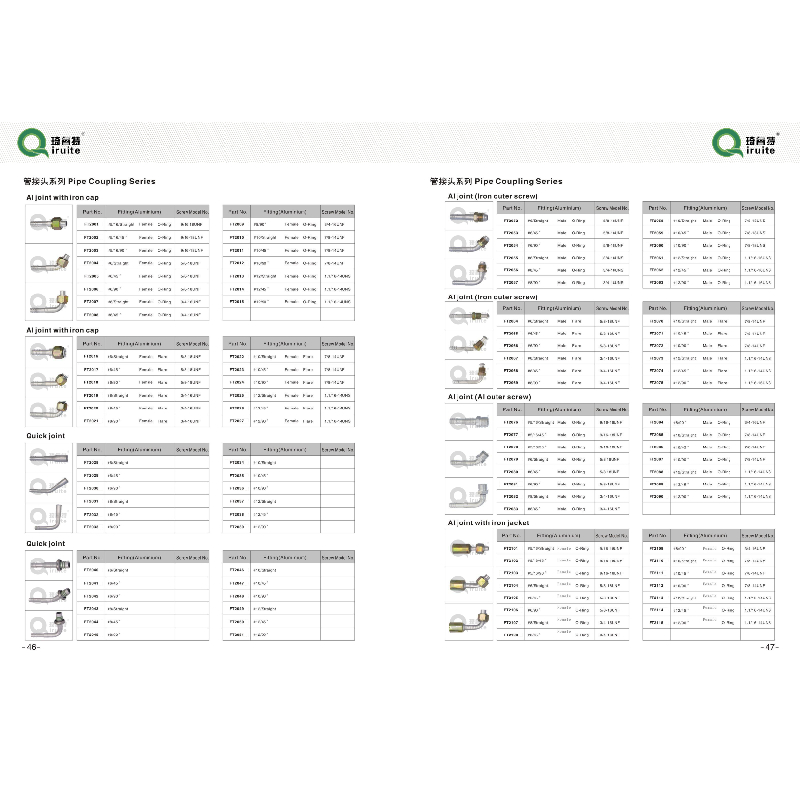
Our featured product, Pipe Coupling Type, is engineered for versatility and reliability, supporting a wide range of compatibility for both aluminum fittings and screw models. With precision-threaded interfaces and O-Ring sealing, it offers optimal resistance against leakage and environmental contamination. Key details as follows:
- Part No. FT2001: #5/16/Straight Female O-Ring — 9/16 18UNF
- Part No. FT2002: #5/16/45° Female O-Ring — 9/16-18UNF
- Part No. FT2003: #5/16/90° Female O-Ring — 9/16-18UNF
For complete details, please visit our official product page: Pipe Coupling Type
| Parameter | Standard Value | Typical Application | Industry Norm |
|---|---|---|---|
| Ball Diameter (mm) | 10~40 mm | Industrial, Automotive, Irrigation | ISO 12240 |
| Thread Spec | M6 / 1/4" / 9/16-18 UNF | Pipe Fittings, Actuators | DIN 71802 |
| Breaking Load (N) | 1200~3400 | High-Torque, Heavy Load | SAE J490 |
| Material | Alloy Steel, Aluminium, Polyacetal | Mechanical Linkage | ASTM A108 |
| Corrosion Resistance (hours) | ≥500 (Salt Spray) | Outdoor Systems | ISO 9227 |
| Operating Temperature (°C) | -40~+120 | Automotive, Machinery | OEM Standard |
| Disconnection Force (N) | 95~225 | Serviceability | BS EN 1432-2 |
- Agricultural Irrigation: Rainbird coupler and ball joint disconnects expedite maintenance in pivot and drip systems.
- Industrial Automation: Pneumatic arms rely on quick release ball joint for maneuverability and tool change efficiency.
- Concrete Construction: Euclid Quick Joint, Euco Quick Joint 200 are standard in expansion jointing, reducing drying time and ensuring seamless structural performance.
- Hydraulic & Pneumatic: Rapid connector systems boost throughput in high-mix assembly lines.
- Automotive Suspension: Quick disconnect joints enable precise camber/caster tuning for performance vehicles and facilitate speedy pit-stop repairs.
- Specialized Chemicals Handling: Use of fast point tub 15kg buff coupling for chemical containment and rapid exchange container111s.
- Q1: What materials are commonly used for quick release ball joint manufacturing?
- A: Stainless steel and high-strength aluminum alloys are preferred for mechanical reliability and corrosion resistance. Advanced polymers such as polyacetal are also used for lightweight applications.
- Q2: What is the standard thread size for industrial couplings like Pipe Coupling Type?
- A: Industry standards found in FT2001/FT2002/FT2003 models include 9/16-18 UNF, M6 and 1/4" threads for global compatibility.
- Q3: How is the disconnection force determined for a quick release ball joint?
- A: Determined through static/pull tests following BS EN 1432-2, with typical working disconnection force between 95–225 N, balancing retention with ease of service.
- Q4: What sealing methods are utilized?
- A: O-Ring elastomeric sealing is predominant; some use PTFE-based seals for aggressive chemical environments.
- Q5: What are the international standards governing quick release ball joint?
- A: ISO 12240 (spherical plain bearings), DIN 71802 (linkage construction), ASTM A108 (material), and OEM-specific hydraulic guidelines.
- Q6: Are there recommended installation torque values?
- A: Yes, depending on thread size and material, typical values range from 8–22 Nm. Always follow equipment technical sheets or manufacturer specification.
- Q7: Which industries benefit most from quick release ball joint assemblies?
- A: Agriculture, automotive, food processing, construction (notably with Euclid/Euco systems), and smart factory automation.
Hebei Qiruite Rubber and Plastic Products Co.,Ltd. proudly maintains ISO-certified production and R&D facilities, as recognized by the China Machinery Industry Federation—see their recent sector whitepaper confirming the evolution of quick-release coupling technology.
Recent technical reviews in the ASME Journal of Mechanical Design document the increasing importance of high-durability ball joints in dynamic assembly lines.
For practical implementation and user reviews, consult the Engineering Tips Forums where hydraulic and irrigation specialists worldwide discuss real-world performance.
More in-depth product testing comparison is available via the International Journal of Mechanical Sciences.
For further technical documentation, custom ordering, or to arrange an engineering consultation on quick release ball joint or any related systems, contact Hebei Qiruite Rubber and Plastic Products Co.,Ltd. at info@hbqrt.com or +86-319-5496989. We supply innovative, tested, and reliable solutions for clients worldwide.
-
Custom Power Steering Hose Kit Guide for Vehicle PerformanceNewsApr.16,2026
-
Guide to High Performance Custom Made Power Steering HosesNewsApr.09,2026
-
Comprehensive Guide to Custom High Pressure Power Steering Hose SolutionsNewsApr.07,2026
-
Comprehensive Guide to CRV Power Steering Hose Maintenance and ReplacementNewsApr.04,2026
-
Comprehensive Guide to CPP Power Steering Hoses for Optimal Vehicle PerformanceNewsMar.31,2026
-
Understanding the Cost to Repair Power Steering Hose and Associated FactorsNewsMar.28,2026
 Afrikaans
 Albanian
 Amharic
 Arabic
 Armenian
 Azerbaijani
 Basque
 Belarusian
 Bengali
 Bosnian
 Bulgarian
 Catalan
 Cebuano
 Corsican
 Croatian
 Czech
Czech
 Danish
 Dutch
Dutch
 Esperanto
 Estonian
 Finnish
 French
 Frisian
 Galician
 Georgian
 German
 Greek
Greek
 Gujarati
 Haitian Creole
 Hausa
Hausa
 Hawaiian
 Hebrew
 Hindi
Hindi
 Miao
Miao
 Hungarian
 Icelandic
 Igbo
Igbo
 Indonesian
 Irish
Irish
 Italian
 Japanese
 Javanese
 Kannada
 Kazakh
 Khmer
Khmer
 Rwandese
 Korean
 Kurdish
 Kyrgyz
 Lao
Lao
 Latin
Latin
 Latvian
 Lithuanian
 Luxembourgish
 Macedonian
 Malgashi
 Malay
Malay
 Malayalam
 Maltese
 Maori
Maori
 Marathi
 Mongolian
 Myanmar
 Nepali
 Norwegian
 Norwegian
 Occitan
 Pashto
 Persian
 Polish
 Portuguese
 Punjabi
 Romanian
 Russian
 Samoan
 Scottish Gaelic
 Serbian
 Sesotho
 Shona
Shona
 Sindhi
 Sinhala
 Slovak
 Slovenian
 Somali
 Spanish
 Sundanese
 Swahili
 Swedish
 Tagalog
 Tajik
Tajik
 Tamil
Tamil
 Tatar
Tatar
 Telugu
 Thai
Thai
 Turkish
 Turkmen
 Ukrainian
 Urdu
Urdu
 Uighur
 Uzbek
Uzbek
 Vietnamese
 Welsh
Welsh
 Bantu
Bantu
 Yiddish
 Yoruba
 Zulu
Zulu
 English