

Comprehensive Guide to Camry Power Steering Hose Replacement and Repair
Camry Power Steering Hose Replacement: A Comprehensive Guide
Replacing a power steering hose in your Toyota Camry can seem daunting, but with the right knowledge and tools, it's a manageable DIY project. A failing power steering hose can lead to leaks, reduced steering assist, and ultimately, a compromised driving experience. This article will guide you through the process, covering identification, necessary tools, step-by-step instructions, and where to source high-quality replacement parts like those available at Hose QRT. Understanding the specifics of your Camry model year is crucial for a successful replacement.

Identifying a Failing Camry Power Steering Hose
Several symptoms indicate a potential power steering hose issue. These include visible leaks near the power steering pump or steering rack, a whining noise when turning the steering wheel, difficulty steering (particularly at low speeds), and a low power steering fluid level. Inspecting the hoses for cracks, bulges, or brittleness is also essential. Don't ignore these signs – early detection can prevent more significant damage to the power steering system. Consistent fluid level checks are a proactive measure.
Key Symptoms: Visible leaks, whining noise, difficult steering, low fluid level, cracked or bulging hoses.
Tools Required for a Camry Power Steering Hose Replacement
Before you begin, gather the necessary tools. These typically include a wrench set (metric), flare nut wrenches (essential for power steering lines to avoid rounding), a screwdriver set, pliers, a fluid catch pan, jack stands, wheel chocks, safety glasses, gloves, and a funnel. Having the correct flare nut wrenches is critical to prevent damage to the fittings. Consider a power steering fluid pump to help bleed the system after the replacement. You can find reliable replacement hoses and associated components at Hose QRT.
Step-by-Step: Replacing Your Camry's Power Steering Hose
1. Safety First: Park on a level surface, engage the parking brake, and chock the rear wheels. Jack up the front of the vehicle and secure it with jack stands. 2. Locate the Hose: Identify the faulty hose. Consult a repair manual specific to your Camry's year for precise location. 3. Drain the Fluid: Place a catch pan under the power steering pump and steering rack. Loosen the return line to allow the fluid to drain. 4. Disconnect the Hose: Using flare nut wrenches, carefully disconnect the hose from the pump and steering rack. Be prepared for some residual fluid spillage. 5. Install the New Hose: Connect the new hose, ensuring a secure fit at both ends. Use new O-rings or washers if included with the replacement hose. 6. Refill the Fluid: Add power steering fluid (refer to your owner's manual for the correct type) using a funnel. 7. Bleed the System: With the engine off, turn the steering wheel lock-to-lock several times to bleed any air from the system. Check the fluid level and add more as needed. 8. Test and Inspect: Start the engine and test the steering. Check for leaks at the hose connections.
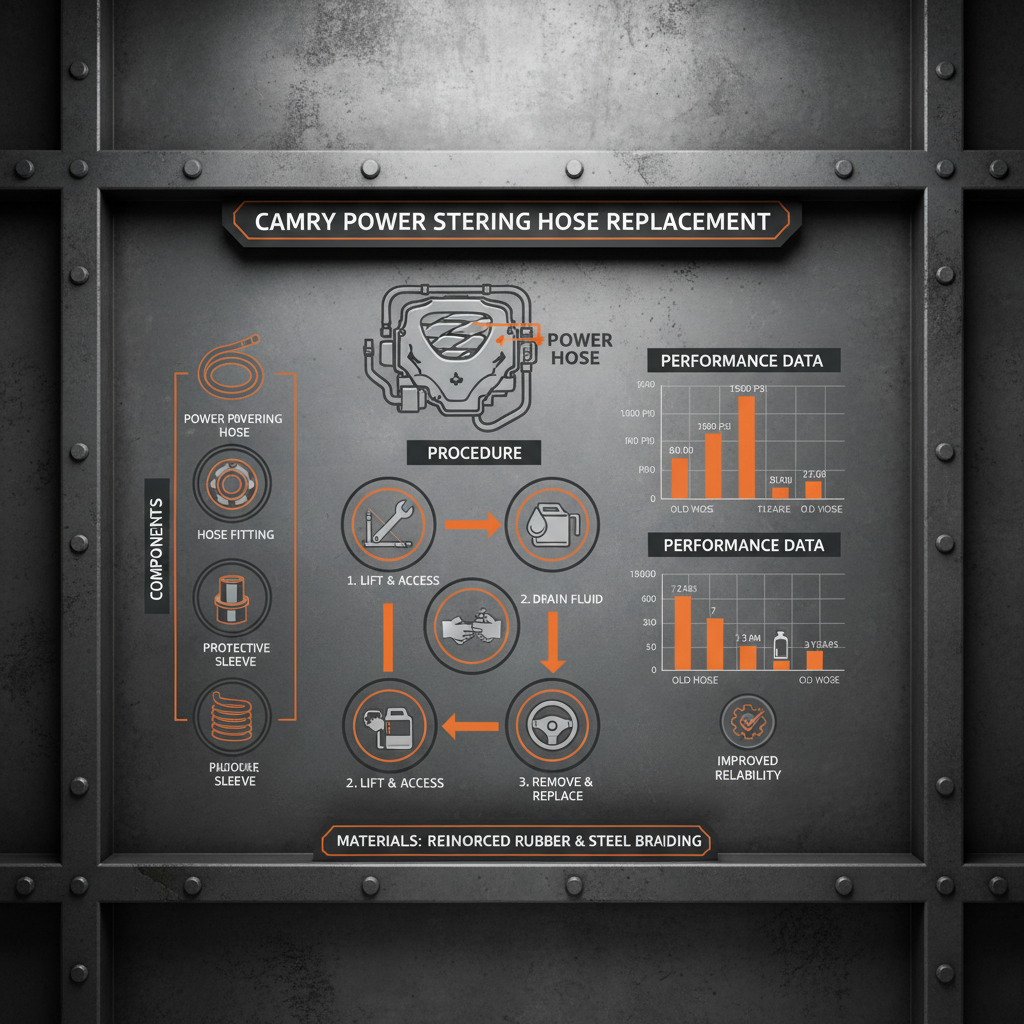
Camry Power Steering Hose Replacement: A Year-to-Year Comparison
The specific hose configurations and access points can vary slightly depending on your Camry’s model year. For example, some earlier models may have a single high-pressure hose, while later models might have separate high and low-pressure hoses. The hose routing can also differ. It’s highly recommended to consult a repair manual specific to your Camry year. Hose QRT provides hoses designed for various Camry generations, ensuring a correct fit.
Choosing the Right Replacement Hose: Quality Matters
Opt for a high-quality replacement hose from a reputable supplier like Hose QRT. Avoid cheap, generic hoses, as they may not meet the required specifications and could fail prematurely. Ensure the hose is specifically designed for your Camry's year and engine type. Using a quality hose will save you time and money in the long run by preventing repeat replacements and potential damage to other components.
Conclusion: Keeping Your Camry Steering Smooth
Replacing a Camry's power steering hose is a manageable task for a reasonably skilled DIY mechanic. By following the steps outlined in this guide and using quality components from a trusted source like Hose QRT, you can restore your Camry's steering performance and maintain its reliability. Don't hesitate to consult a professional if you encounter any difficulties or are unsure about any part of the process.
Frequently Asked Questions (FAQs)
How long does a Camry power steering hose typically last?
The lifespan of a power steering hose varies depending on driving conditions, exposure to extreme temperatures, and the quality of the hose. Generally, a hose can last between 5 to 10 years. However, visual inspection and checking for leaks are crucial. Hoses become brittle over time, increasing the risk of failure. Regularly inspecting and replacing as needed is vital to prevent system failure. Choosing a high-quality replacement hose from a supplier like Hose QRT can extend the hose's lifespan due to superior material quality.
What type of power steering fluid should I use?
Using the correct power steering fluid is essential. Refer to your Camry's owner's manual for the recommended fluid type. Using the wrong fluid can damage the power steering pump and other components. Toyota typically specifies a specific fluid type; using a universal fluid is not recommended.
Can I drive my Camry with a leaking power steering hose?
Driving with a leaking power steering hose is not recommended. A leak can lead to a loss of power steering assist, making it difficult to control the vehicle, especially at low speeds. A severe leak can also damage the power steering pump. It’s best to address the leak as soon as possible. If the leak is significant, have the vehicle towed to a mechanic or perform the replacement yourself promptly.
What is the importance of using flare nut wrenches?
Flare nut wrenches are specifically designed to grip the fittings on power steering hoses without rounding them off. Regular open-end wrenches can easily slip and damage the fittings, making them difficult to remove and potentially requiring the replacement of additional components. Using flare nut wrenches ensures a secure grip and prevents damage, making the replacement process much smoother and safer.
-
Custom Power Steering Hose Kit Guide for Vehicle PerformanceNewsApr.16,2026
-
Guide to High Performance Custom Made Power Steering HosesNewsApr.09,2026
-
Comprehensive Guide to Custom High Pressure Power Steering Hose SolutionsNewsApr.07,2026
-
Comprehensive Guide to CRV Power Steering Hose Maintenance and ReplacementNewsApr.04,2026
-
Comprehensive Guide to CPP Power Steering Hoses for Optimal Vehicle PerformanceNewsMar.31,2026
-
Understanding the Cost to Repair Power Steering Hose and Associated FactorsNewsMar.28,2026
 Afrikaans
 Albanian
 Amharic
 Arabic
 Armenian
 Azerbaijani
 Basque
 Belarusian
 Bengali
 Bosnian
 Bulgarian
 Catalan
 Cebuano
 Corsican
 Croatian
 Czech
Czech
 Danish
 Dutch
Dutch
 Esperanto
 Estonian
 Finnish
 French
 Frisian
 Galician
 Georgian
 German
 Greek
Greek
 Gujarati
 Haitian Creole
 Hausa
Hausa
 Hawaiian
 Hebrew
 Hindi
Hindi
 Miao
Miao
 Hungarian
 Icelandic
 Igbo
Igbo
 Indonesian
 Irish
Irish
 Italian
 Japanese
 Javanese
 Kannada
 Kazakh
 Khmer
Khmer
 Rwandese
 Korean
 Kurdish
 Kyrgyz
 Lao
Lao
 Latin
Latin
 Latvian
 Lithuanian
 Luxembourgish
 Macedonian
 Malgashi
 Malay
Malay
 Malayalam
 Maltese
 Maori
Maori
 Marathi
 Mongolian
 Myanmar
 Nepali
 Norwegian
 Norwegian
 Occitan
 Pashto
 Persian
 Polish
 Portuguese
 Punjabi
 Romanian
 Russian
 Samoan
 Scottish Gaelic
 Serbian
 Sesotho
 Shona
Shona
 Sindhi
 Sinhala
 Slovak
 Slovenian
 Somali
 Spanish
 Sundanese
 Swahili
 Swedish
 Tagalog
 Tajik
Tajik
 Tamil
Tamil
 Tatar
Tatar
 Telugu
 Thai
Thai
 Turkish
 Turkmen
 Ukrainian
 Urdu
Urdu
 Uighur
 Uzbek
Uzbek
 Vietnamese
 Welsh
Welsh
 Bantu
Bantu
 Yiddish
 Yoruba
 Zulu
Zulu
 English