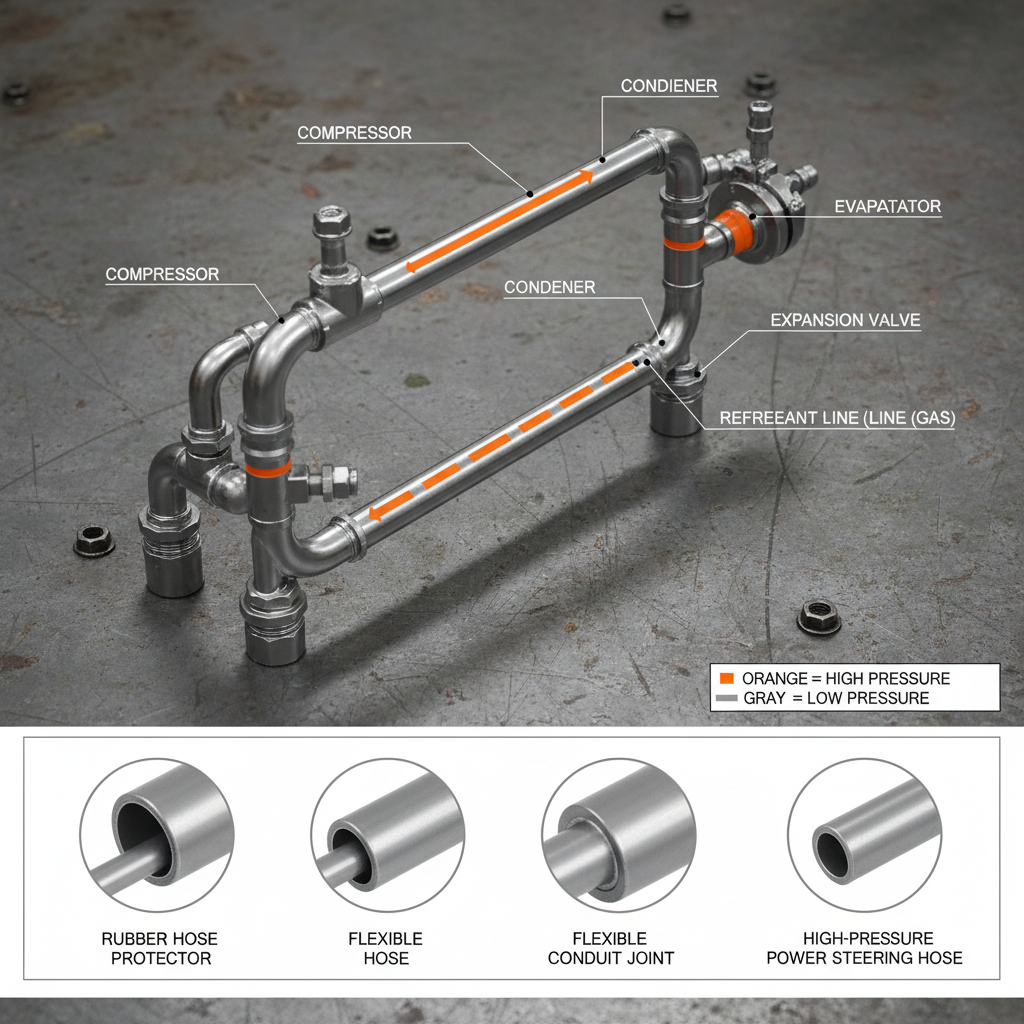
When standard braking components fail to meet the precise routing or pressure requirements of a high-performance vehicle, the shift toward custom made brake hoses becomes a critical engineering necessity. Unlike off-the-shelf alternatives, tailored hydraulic lines are designed to eliminate excessive expansion under pressure and fit perfectly within constrained engine bays or chassis configurations.
The integrity of a braking system depends entirely on the ability of the hoses to maintain constant hydraulic pressure from the master cylinder to the calipers. In industrial and automotive applications, where heat cycles and abrasion are constant threats, utilizing materials that offer superior corrosion and aging resistance is not just a preference, but a safety mandate.
For procurement managers and engineers, selecting a partner capable of independent R&D and strict adherence to technical standards—such as the QC/T 664-2000 benchmarks—ensures that custom components do not become the weak link in a vehicle's safety architecture.

Engineering Requirements for Precision Braking Lines

The primary challenge in braking system design is the balance between flexibility and rigidity. Standard hoses often suffer from "ballooning"—a phenomenon where the hose diameter expands under heavy braking, absorbing hydraulic fluid and resulting in a "spongy" pedal feel. Custom made brake hoses solve this by utilizing reinforced textile yarns and high-density nylon linings that minimize volumetric expansion.
Beyond pressure retention, the external environment poses significant risks. Rubber components are subjected to road debris, salt, and extreme temperature fluctuations. This necessitates the use of materials with high abrasion resistance and aging stability to prevent premature cracking or leaking, which could lead to catastrophic system failure.
Furthermore, the integration of these hoses into complex assemblies requires precise lengths and fitting orientations. Customization allows for the exact specification of the inner diameter (ID) and outer diameter (OD), ensuring that the hydraulic flow is optimized without introducing unnecessary bends that could restrict fluid movement.
Technical Core of Custom Hydraulic Hose Construction
A high-performance brake hose is a composite structure. The core consists of a thick inner nylon lining designed for permeation resistance, ensuring that brake fluid does not seep through the hose walls over time. This is reinforced by a layer of braided textile yarn, which provides the structural strength needed to withstand high-pressure spikes during emergency braking.
The outer layer typically utilizes specialized rubber compounds, such as EPDM, known for its environmental resilience. A significant technical hurdle in the industry has been the bonding of EPDM rubber with nylon and polyester yarns; solving this bonding issue is what separates industrial-grade hoses from low-cost alternatives.
The production process—involving extrusion, braiding, and vulcanization—must be tightly controlled. Vulcanization, in particular, transforms the raw rubber into a durable, elastic material that maintains its shape while offering the necessary flexibility for steering and suspension movement.
Critical Application Scenarios for Tailored Brake Hoses
Custom braking solutions are indispensable in the modification of heavy-duty machinery and performance automotive sectors. In off-road racing, for instance, hoses are exposed to extreme abrasion from rocks and mud. In these cases, the use of a protector spiral guard—made of polypropylene (PP)—is essential to shield the rubber from mechanical wear.
Industrial hydraulic systems in manufacturing plants also require custom lengths to fit specific machine footprints. Whether it is for power steering integration or complex brake manifolds, the ability to produce tailor-made products allows engineers to reduce the number of coupling joints, thereby reducing potential leak points in the system.
Additionally, specialized transport vehicles operating in corrosive environments (such as chemical tankers or marine vessels) require hoses with enhanced corrosion resistance. Customization allows for the selection of specific rubber grades that can withstand chemical exposure without degrading the structural integrity of the reinforcement layer.
Evaluating Performance via Pressure and Permeation Metrics
To verify the quality of a custom hose, it must undergo rigorous testing based on established standards like QC/T 664-2000. Key performance indicators include burst pressure, permeation rates, and flexibility cycles. A superior hose will demonstrate minimal fluid loss through the walls even when subjected to prolonged vacuum or high-pressure conditions.
When comparing customized reinforced hoses against standard rubber lines, the difference in pressure stability is stark. The reduction in hose expansion directly correlates to a more immediate response time in the braking system, which is critical for safety-critical applications.
custom made brake hoses Performance Metrics
As illustrated in the data, customized solutions typically outperform industry benchmarks in areas such as abrasion resistance and pressure stability. This is achieved through the use of optimized braiding densities and superior rubber-to-nylon bonding technologies that prevent internal slippage during high-pressure events.
Strategic Procurement and Customization Workflow
Procuring custom hydraulic components requires a detailed technical specification sheet. Buyers must define the exact internal diameter (ID), outer diameter (OD), and the specific environment the hose will encounter. Failing to specify the chemical nature of the brake fluid or the peak operating temperature can lead to the selection of an inappropriate rubber compound.
A robust procurement workflow involves a three-step verification: first, the material compatibility check; second, the prototype testing for fit and pressure; and third, the third-party validation against standards such as QC/T 664-2000. This ensures that the final product meets the safety requirements of the target market, whether in Asia, America, or Europe.
Moreover, considering the lifecycle cost is essential. While custom hoses may have a higher initial cost, their extended service life—due to better abrasion and aging resistance—reduces the frequency of replacement and the risk of costly system downtime.
Future Trajectories in Rubber and Polymer Hose Technology
The industry is gradually moving toward more sustainable, eco-friendly rubber compounds that do not compromise on pressure resistance. There is a growing interest in bio-based polymers that can replace traditional petroleum-derived EPDM, potentially reducing the environmental footprint of automotive manufacturing.
Technological innovation is also focusing on the integration of "smart" materials. In the future, we may see hoses with embedded sensors capable of detecting micro-leaks or pressure drops in real-time, allowing for predictive maintenance before a total failure occurs. This would be particularly valuable in heavy-industrial sewer cleaning or power steering systems.
Additionally, the refinement of the extrusion process is expected to allow for even thinner walls with higher burst pressures, reducing the overall weight of the braking system. This trend is likely to be driven by the shift toward electric vehicles (EVs), where weight reduction is critical for maximizing battery range.
Decision Matrix for Selecting Brake Hose Specifications
Choosing the right hose requires matching the technical specifications to the operational environment. For instance, a hose intended for a high-heat engine bay requires different aging resistance properties than one used in a cold-climate industrial application. The following matrix provides a guide for selecting the appropriate configuration based on use-case requirements.
When evaluating potential suppliers, focus on their ability to provide independent lab results and their experience in solving complex bonding issues between lining and reinforcement. A supplier that can customize both the hose and the accompanying protection sleeve offers a more integrated and reliable solution.
| Application Type | Core Material Requirement | Recommended Reinforcement | Primary Risk Factor |
|---|---|---|---|
| Performance Racing | High-Density Nylon | Double-Braided Yarn | Pressure Spikes |
| Heavy Industrial | EPDM Rubber | Textile Yarn + PP Guard | Mechanical Abrasion |
| Standard Automotive | Eco-friendly Rubber | Single-Layer Braiding | Thermal Aging |
| Off-Road/Mining | Corrosion-Resistant EPDM | Heavy-Duty Textile | Chemical Exposure |
| EV Specialized | Lightweight Polymer | Optimized Synthetic Fiber | Weight/Efficiency |
| Marine/Coastal | Salt-Resistant Rubber | Anti-Corrosive Yarn | Saline Corrosion |
Ultimately, the decision should be based on a balance of safety, longevity, and fit. For those seeking high-precision hydraulic components, reviewing the technical capabilities available through www.hoseqrt.com can provide the necessary baseline for a secure procurement strategy.
Frequently Asked Questions
Conclusion
The transition to custom made brake hoses is a strategic move for any operator prioritizing safety and precision in hydraulic braking. By focusing on the synergy between the inner nylon lining, the braided reinforcement, and the resilient outer rubber, engineers can eliminate the common failure points associated with standard components.
As the industry evolves toward lighter and more eco-friendly materials, the importance of partnering with a manufacturer capable of independent R&D and strict quality control remains paramount. For detailed specifications and tailored hydraulic solutions, the resources at www.hoseqrt.com provide a professional starting point for system optimization.